On this page
A liquidation manifest is the line-by-line list of what's in a lot: item codes, descriptions, quantities and the retail price of each item. Reading one well comes down to three habits. Find the handful of lines that carry most of the value. Research what those items actually sell for, in the condition the lot is graded. Then add freight before you compare the result with the price.
This guide walks through every column, shows the math on an example manifest, and lists the warning signs that should make you slow down. Every lot on Palle Liquidation-US has a manifest, so you can practise on real lots as you read.
What a liquidation manifest is
When a retailer or manufacturer clears returns, overstock or shelf pulls, the goods are counted and listed before they're sold. That list is the manifest. It tells you what was put on the pallet or truck, so you can price a lot before you commit to it.
A manifest describes contents. It doesn't tell you condition item by item, and it doesn't tell you what anything will resell for. Condition comes from the lot's grade (see what the condition grades mean). Resale value comes from your own research. Treat the manifest as the starting point for that research.
On Palle Liquidation-US, manifests are prepared by our own warehouse team for lots we sort and ship from our own dock. Small count variances can happen with any manifest, which is why the dispute rules further down use a threshold rather than a single-unit test.
Each manifest column, explained
Column names vary between sellers, but most manifests carry the same five pieces of information.
- SKU or UPC. The item code. A SKU is a retailer's or seller's internal code; a UPC is the barcode number printed on retail packaging. A UPC is the most reliable way to find the exact product online. A SKU helps you match lines within a lot and across lots.
- Description (Item). The product name as it appeared in the source system. Good descriptions name the brand, model and size. Poor ones say things like “kitchen item” or “assorted”.
- Qty. How many units of that line are in the lot. Multiply everything else by this number.
- Unit retail (MSRP). The retail price for one unit, usually the manufacturer's suggested price or the original retail list price. It's a reference point, and often higher than what the item sold for in stores.
- Extended retail (Ext. retail). Qty × unit retail for that line. Added up across all lines, it gives the lot's total retail value, the number most listings quote.
What “retail value” means (and what it doesn't)
Total retail value is useful for one job: comparing the size and price of lots on the same basis. A lot priced at 20% of retail is cheaper relative to its contents than one at 30%, if the contents are similar. The lot page shows this as “price vs. retail”.
Retail value is not what you'll get when you sell. Returned items resell below new prices. Some MSRPs are list prices nobody actually paid. Some items are last season's models. And you won't sell every unit. Resellers who budget on retail value, rather than on sold prices, overpay.
Use retail value to shortlist lots. Use sold prices to decide what to pay.
How to estimate resale value
You don't need to price every line. In most manifests a few lines hold a large share of the value, so start there and work down until the remaining lines are small enough to estimate as a group.
- Sort by extended retail. Research the top lines first. The lot page's “Top 3 lines” figure tells you how much of the retail value those three carry.
- Look up sold prices, not asking prices. Use completed or sold listings on the marketplaces where you sell, and match condition: open-box or used prices for returns, new prices only for sealed stock.
- Estimate sell-through. Sell-through is the share of units you expect to sell within your normal selling window. Returns have defects and missing parts, so plan for less than 100%. Your own records from past lots are the best guide.
- Subtract your selling costs. Marketplace fees, shipping to your customer, packaging, and your time to test, clean and list.
- Add freight to the price. Your real cost is the price plus delivery. Divide by units to get landed cost per unit.
Worked example: pricing a six-line manifest
The manifest below is an EXAMPLE, invented for this guide. The item names, prices and freight figure are made up to show the math. They are not a Palle Liquidation-US lot or quote.
| SKU | Item | Qty | Unit retail | Ext. retail |
|---|---|---|---|---|
| EX-1001 | Stand mixer, 5 qt, tilt-head | 4 | $279.99 | $1,119.96 |
| EX-1002 | Air fryer, 6 qt, digital | 12 | $89.99 | $1,079.88 |
| EX-1003 | Silicone utensil set, 5 pc | 60 | $12.99 | $779.40 |
| EX-1004 | Glass food storage set, 18 pc | 30 | $24.99 | $749.70 |
| EX-1005 | Nonstick cookware set, 10 pc | 6 | $119.99 | $719.94 |
| EX-1006 | Cordless handheld vacuum | 10 | $59.99 | $599.90 |
| Total | 122 | $5,048.78 |
Say this is a Customer Return pallet listed at $900, and you assume $250 for freight to your ZIP (a made-up number for the math; always use the estimator on the real lot). Landed cost is $1,150.
- Price vs. retail: $900 ÷ $5,048.78 ≈ 18%. Landed vs. retail: $1,150 ÷ $5,048.78 ≈ 23%.
- Landed cost per unit: $1,150 ÷ 122 units ≈ $9.43.
- Value concentration: the top two lines (mixers and air fryers) are $2,199.84, about 44% of retail, but only 16 units.
- Resale research (example numbers): mixers sell used for about $140, air fryers $40, utensil sets $6, storage sets $12, cookware sets $55, vacuums $25.
- Sell-through (example assumptions): 3 of 4 mixers, 10 of 12 air fryers, 57 of 60 utensil sets, 27 of 30 storage sets, 5 of 6 cookware sets, 8 of 10 vacuums.
- Gross resale: $420 + $400 + $342 + $324 + $275 + $200 = $1,961, or about 39% of retail.
- Rough range: if sold prices come in 25% lower than your research, gross falls to about $1,470. So plan on roughly $1,470–$1,960 before selling costs.
Against a landed cost of $1,150, the low end leaves about $320 before fees, packaging and labour. An online seller paying marketplace fees and shipping on each order might clear very little. A bin store with no per-order fees and a customer base for kitchen goods might do fine. Same manifest, different answer, which is why the method matters more than any rule of thumb about percent of retail.
Notice what drives the result: 16 high-value units carry almost half the retail value. If two mixers turn out to be defective, the numbers move a lot. When value is that concentrated, research those lines carefully and buy with a margin of safety.
Red flags to look for
- Vague lines. “Assorted”, “misc”, “general merchandise” or a bare category name with a large quantity. You can't research what you can't identify.
- Missing quantities or prices. A line without a qty or unit retail can't be valued. Ask before you buy.
- One line dominating the value. If a single item is a big share of retail, the lot's value depends on that item's condition. Check the “Top 3 lines” figure on the lot page.
- Retail prices that look inflated. If an item's unit retail is far above anything you can find it selling for new, discount it in your math.
- Units that don't add up. The lot's unit count should match the manifest total. If the listing and the manifest disagree, ask.
- Heavy, low-value lines. Bulky items with low resale prices add freight weight and take space without adding much value.
Manifested vs. unmanifested pallets
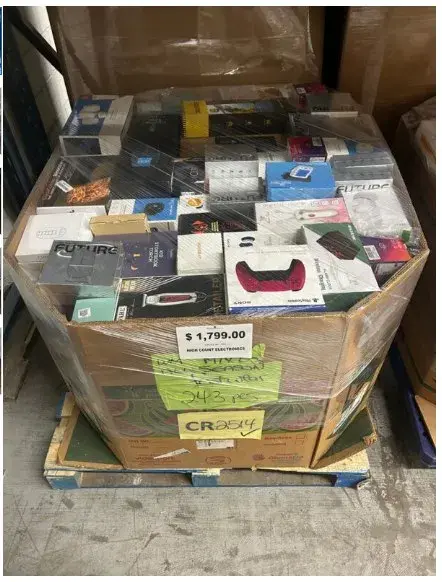
A manifested pallet comes with a list of its contents. An unmanifested pallet is sold by description only, such as “mixed general merchandise, about 200 units”. Unmanifested loads are usually cheaper per unit because you're taking on more uncertainty.
Manifested lots suit buyers who sell item by item online, who need to research prices before buying, or who want to track recovery against a known retail value. Unmanifested loads can work for some bin stores and flea-market sellers, where variety is part of the appeal and nothing is priced individually. Even then, the manifest is what gives you a basis for a dispute if a lot arrives well short.
Every lot Palle Liquidation-US sells is manifested, from single case packs to truckloads.
Using the manifest table on Palle Liquidation-US
Each lot page has a Manifest section with a table of every line. You can:
- Search the manifest by item name or SKU, for example to check how many units of one brand are in the lot. The totals row updates to show the filtered units and retail value.
- Sort by item name, quantity, unit retail or extended retail. It opens sorted by extended retail, so the highest-value lines are at the top.
- Download the manifest as a CSV, add your own columns for sold prices and sell-through, and keep it with your purchase records.
- Read the summary above the table: price vs. retail, the share of value in the top 3 lines, the number of distinct items, and the highest-value items. The key facts panel shows the price per unit.
Pair the manifest with the freight estimate on the same page. Enter your ZIP and you'll see an estimate that includes dock or liftgate delivery. Our freight guide explains what goes into it.
If a lot arrives below its manifest
Lots are sold as-is according to their condition grade, so an individual defective unit in a returns or salvage lot isn't grounds for a refund. Under our Return & Refund Policy you can request a return within 15 days of pickup or delivery, including when an order doesn't match its written listing in a material way.
To raise a problem, contact us within 15 days of pickup or delivery with your order number, photos or videos and any freight paperwork. Returns need our written approval before anything is sent back. Count and photograph the contents as you unpack, before anything is sold or mixed with other stock. That record is what makes a discrepancy easy to prove. See also what to do if the manifest doesn't match.
FAQ
Accurate enough to price a lot, but small count variances are normal on any manifest. On Palle Liquidation-US, if an order doesn't match its written listing in a material way, contact us within 15 days of pickup or delivery under our Return & Refund Policy.
No. Retail value is the original list price. Your resale value depends on condition, current sold prices on your channel and how many units you actually sell. Use sold listings to estimate it.
If you sell item by item or need to research prices before buying, usually yes, because you can value the lot before you commit. If you sell by the bin or by the bag, variety may matter more than knowing each item.
Start with the lines that make up most of the extended retail, often the top five to ten. Estimate the remaining small lines as a group, using a conservative price per unit.
Yes. Every lot page has a Download manifest (CSV) link above the manifest table, so you can add your own research columns in a spreadsheet.
Sourcing Desk · Buying & grading
The team that buys our inbound loads, grades every pallet and writes the manifests.